Radiocarbon
In this tutorial, we will simulate the radiocarbon age using the AIBECS by
defining the transport
T(p)and the sources and sinksG(x,p),defining the parameters
p,generating the state function
F(x,p)and solving the associated steady-state problem,and finally making a plot of our simulated radiocarbon age.
Note
Although this tutorial is self-contained, it is slightly more complicated than the first tutorial for simulating the ideal age. (So do not hesitate to start with the idealage tutorial if you wish.)
The tracer equation for radiocarbon is
where the first term on the right of the equal sign represents the air–sea gas exchange with a piston velocity
Note
We need not specify the value of the atmospheric radiocarbon concentration because it is not important for determining the age of a water parcel — only the relative concentration
We start by selecting the circulation for Radiocarbon.
(And this time, we are using the OCCA matrix by Forget (2010) [1].)
using AIBECS
using JLD2 # required by `OCCA.load`
grd, T_OCCA = OCCA.load()
(, sparse([1, 2, 9551, 9606, 1, 2, 3, 57, 9552, 9607 … 79928, 84632, 84659, 84660, 84661, 79891, 79929, 84633, 84660, 84661], [1, 1, 1, 1, 2, 2, 2, 2, 2, 2 … 84660, 84660, 84660, 84660, 84660, 84661, 84661, 84661, 84661, 84661], [2.2826279842870655e-7, 1.8030621712982388e-10, -2.202759122121374e-7, -1.669794081839543e-8, -8.32821319857397e-8, 3.6454996849707203e-7, -2.4345873581518986e-8, 2.346272528650749e-8, -3.294980961099172e-7, 6.798120022902578e-9 … -2.337773104642457e-8, -1.0853897038905248e-8, -2.4801404742669764e-8, 7.658935255067088e-8, -2.49410804832536e-8, -2.2788300189327118e-9, -3.386139290468414e-8, -2.0539768803799346e-8, -1.8193948479846445e-8, 5.864674518359535e-8], 84661, 84661))The local sources and sinks are simply given by
function G(R, p)
    @unpack λ, h, Ratm, τ = p
    return @. λ / h * (Ratm - R) * (z ≤ h) - R / τ
end
G (generic function with 1 method)We can define z via
z = depthvec(grd)84661-element Vector{Float64}:
25.0
25.0
25.0
25.0
25.0
25.0
25.0
25.0
25.0
25.0
⋮
5062.25
5062.25
5062.25
5062.25
5062.25
5062.25
5062.25
5062.25
5062.25In this tutorial we will specify some units for the parameters. Such features must be imported to be used
import AIBECS: @units, unitsWe define the parameters using the dedicated API from the AIBECS, including keyword arguments and units this time
@units struct RadiocarbonParameters{U} <: AbstractParameters{U}
    λ::U    | u"m/yr"
    h::U    | u"m"
    τ::U    | u"yr"
    Ratm::U | u"M"
end
units (generic function with 53 methods)For the air–sea gas exchange, we use a constant piston velocity
p = RadiocarbonParameters(
    λ = 50u"m" / 10u"yr",
    h = grd.δdepth[1],
    τ = 5730u"yr" / log(2),
    Ratm = 42.0u"nM"
)
Main.RadiocarbonParameters{Float64}
λ = 5.0 (m yr⁻¹)
h = 50.0 (m)
τ = 8266.64258429376 (yr)
Ratm = 4.2000000000000006e-8 (M)Note
The parameters are converted to SI units when unpacked. When you specify units for your parameters, you must either supply their values in that unit.
We build the state function F and the corresponding steady-state problem (and solve it) via
F = AIBECSFunction(T_OCCA, G)
x = zeros(length(z)) # an initial guess
prob = SteadyStateProblem(F, x, p)
R = solve(prob, CTKAlg()).u
84661-element Vector{Float64}:
3.782989042400264e-5
3.777181712272232e-5
3.660371729335564e-5
3.707310908733552e-5
3.716239375219126e-5
3.7168497048614304e-5
3.709453566001736e-5
3.7159561038925754e-5
3.723606252569647e-5
3.7349967402672724e-5
⋮
3.635099586594514e-5
3.634755896919857e-5
3.6339096931777565e-5
3.6347484352324805e-5
3.63826810104347e-5
3.6421920073910325e-5
3.647280866120177e-5
3.6488010171142744e-5
3.650169024828974e-5This should take a few seconds on a laptop. Once the radiocarbon concentration is computed, we can convert it into the corresponding age in years, via
@unpack τ, Ratm = p
C14age = @. log(Ratm / R) * τ * u"s" |> u"yr"
84661-element Vector{Quantity{Float64, 𝐓, Unitful.FreeUnits{(yr,), 𝐓, nothing}}}:
864.4434447899139 yr
877.1434574053698 yr
1136.827180697325 yr
1031.4929288324006 yr
1011.6079751302298 yr
1010.2504299781357 yr
1026.7165651310008 yr
1012.2381261585998 yr
995.2368392305344 yr
969.9878310854215 yr
⋮
1194.1001375754036 yr
1194.881765135638 yr
1196.8065376635063 yr
1194.8987355093514 yr
1186.897702814917 yr
1177.9868554324005 yr
1166.4447909128373 yr
1163.0000529492802 yr
1159.9013058938976 yrand plot it at 700 m using the horizontalslice Plots recipe
using Plots
plothorizontalslice(C14age, grd, depth = 700u"m", color = :viridis)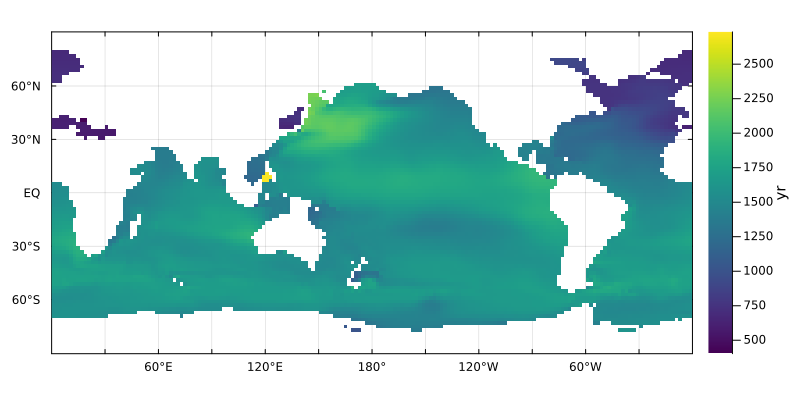
look at a zonal average using the zonalaverage plot recipe
plotzonalaverage(C14age, grd; color = :viridis)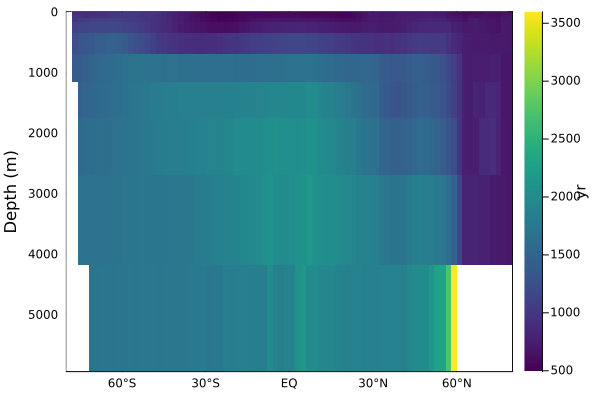
or look at a meridional slice through the Atlantic at 30°W using the meridionalslice plot recipe
plotmeridionalslice(C14age, grd, lon = -30, color = :viridis)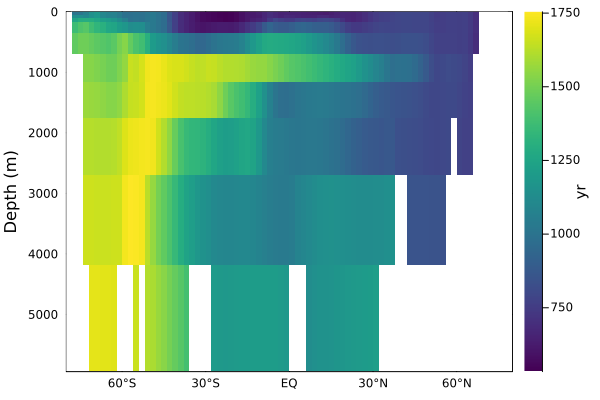
This page was generated using Literate.jl.
Forget, G., 2010: Mapping Ocean Observations in a Dynamical Framework: A 2004–06 Ocean Atlas. J. Phys. Oceanogr., 40, 1201–1221, doi:10.1175/2009JPO4043.1) ↩︎